
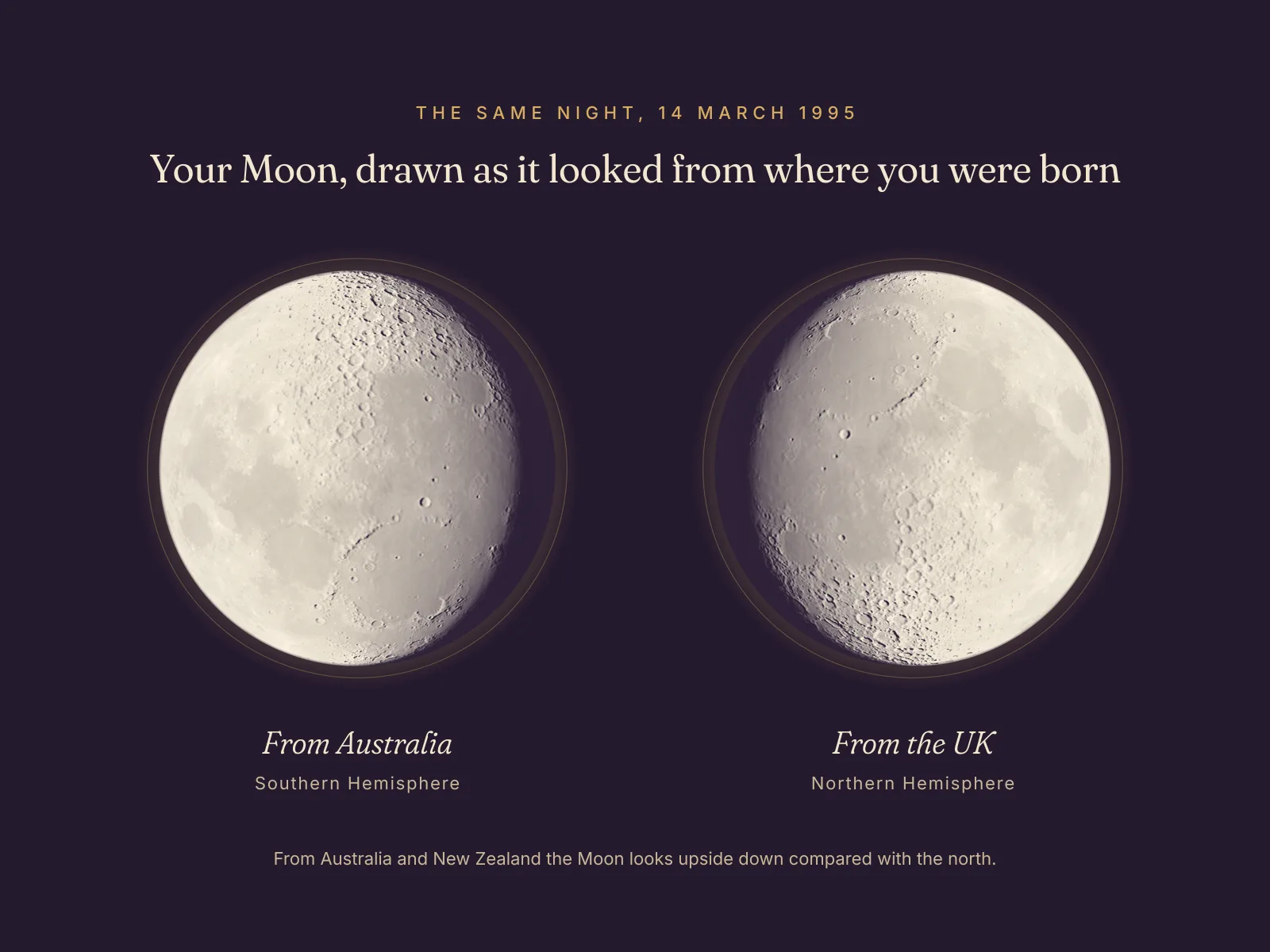
Everyone knows their star sign. Almost nobody knows their moon phase, and it is arguably the more personal of the two. The Sun sign tells you the month. The Moon's phase on the night you were born is a single point in a cycle that repeats only every 29 and a half days, and astrologers have been reading it as a clue to temperament for about a century.
How a moon phase works
The phase has nothing to do with the Earth's shadow. It is simply how much of the Moon's sunlit half is turned towards us. When the Moon sits between the Earth and the Sun, we see its dark side: a New Moon. Two weeks later it sits opposite the Sun and we see the whole lit face: a Full Moon. Everything else is in between, growing (waxing) on the way to full and shrinking (waning) on the way back.
Astronomers measure this as the angle between the Sun and the Moon as seen from Earth. At 0 degrees the Moon is new, at 90 it is at First Quarter, at 180 it is full, at 270 it is at Last Quarter. That angle is what our free calculator works out for your birth date, and it is why you do not need a birth time: the Moon moves only about 12 degrees a day.
The eight birth moon phases
The astrologer Dane Rudhyar divided the cycle into eight phases of 45 degrees each in his book The Lunation Cycle, and gave each a character. Here they are in plain words, with a little of the old moon folklore that goes with them. They describe tendencies, not rules.
New Moon: the beginner
Born in the dark, when the Moon and Sun rise together. Instinctive, spontaneous and open to the new, someone who learns by doing and trusts their gut. Old folklore says the New Moon is the lucky time for fresh starts, like moving into a new home.
Waxing Crescent: the striver
The first sliver of light. Brave and hopeful, pushing forward and breaking new ground. A growing Moon was said to give a newborn strength and good luck.
First Quarter: the builder
Half lit and growing. Decisive, driven and at their best when there is something to get done. In folklore, prosperity grows as the Moon grows.
Waxing Gibbous: the perfecter
Nearly full. Thoughtful, devoted and always refining, the one who asks how it could be even better.
Full Moon: the illuminator
Fully lit, opposite the Sun. Aware, warm and lit up by other people, someone who sees the whole picture. Many cultures have gathered and celebrated under the Full Moon for thousands of years.
Waning Gibbous: the sharer
Just past full. Wise and generous, a natural teacher who passes on what they know. In modern moon rituals this is the Moon of gratitude and giving back.
Last Quarter: the reformer
Half lit and shrinking. Independent and questioning, often ahead of their time, and ready to let go of what no longer works.
Waning Crescent: the visionary
The last sliver before the dark. Intuitive, gentle and often called an old soul, with an eye on what comes next. In modern moon rituals this is the Moon for rest and dreaming before a new beginning.
Why most moon pictures are wrong for Australians
Here is the part almost every moon print and app gets wrong. From Australia, New Zealand, South Africa and South America, the Moon appears upside down compared with the view from the north. A waxing Moon is lit on the left, not the right. The stock picture of a First Quarter Moon, lit on the right, is simply not what a baby born in Melbourne had in the sky. Our calculator and our Moon Phase Print draw the Moon as it looked from the birthplace.
Does the Moon's sign matter too?
Yes, and it is a different thing. The phase is about the Moon's relationship with the Sun. The sign is which part of the zodiac the Moon was passing through, which changes about every two and a half days and describes, in astrology, how you feel and what makes you feel safe. The calculator shows both, and names the sign only when it stayed the same all day if you do not know your birth time.
A note on what this can and cannot tell you
A moon phase is one small lens. It will not tell you who you are, and it should never be used to predict anything. Treat it the way you would treat a good description from a friend: something to hold up and see what fits. If you want the whole picture rather than one lens, that is what a full reading is for.
Instant, drawn as it looked from your birthplace, with the meaning and a card to share.
Questions
Do I need my birth time to find my moon phase?
No. The date and place are enough for the phase. A time makes the percentage exact and confirms the Moon's sign.
What is the rarest moon phase to be born under?
None is truly rare. Each of the eight phases lasts about three and a half days, so roughly one person in eight is born under each. The exact moments of New and Full Moon are rare, which is why the calculator gives those names a window of about a day either side.
Is being born on a full moon lucky?
Folklore says different things in different places. Astrologers read a Full Moon birth as a strong awareness of other people rather than as luck. Treat it as a description, not a promise.