
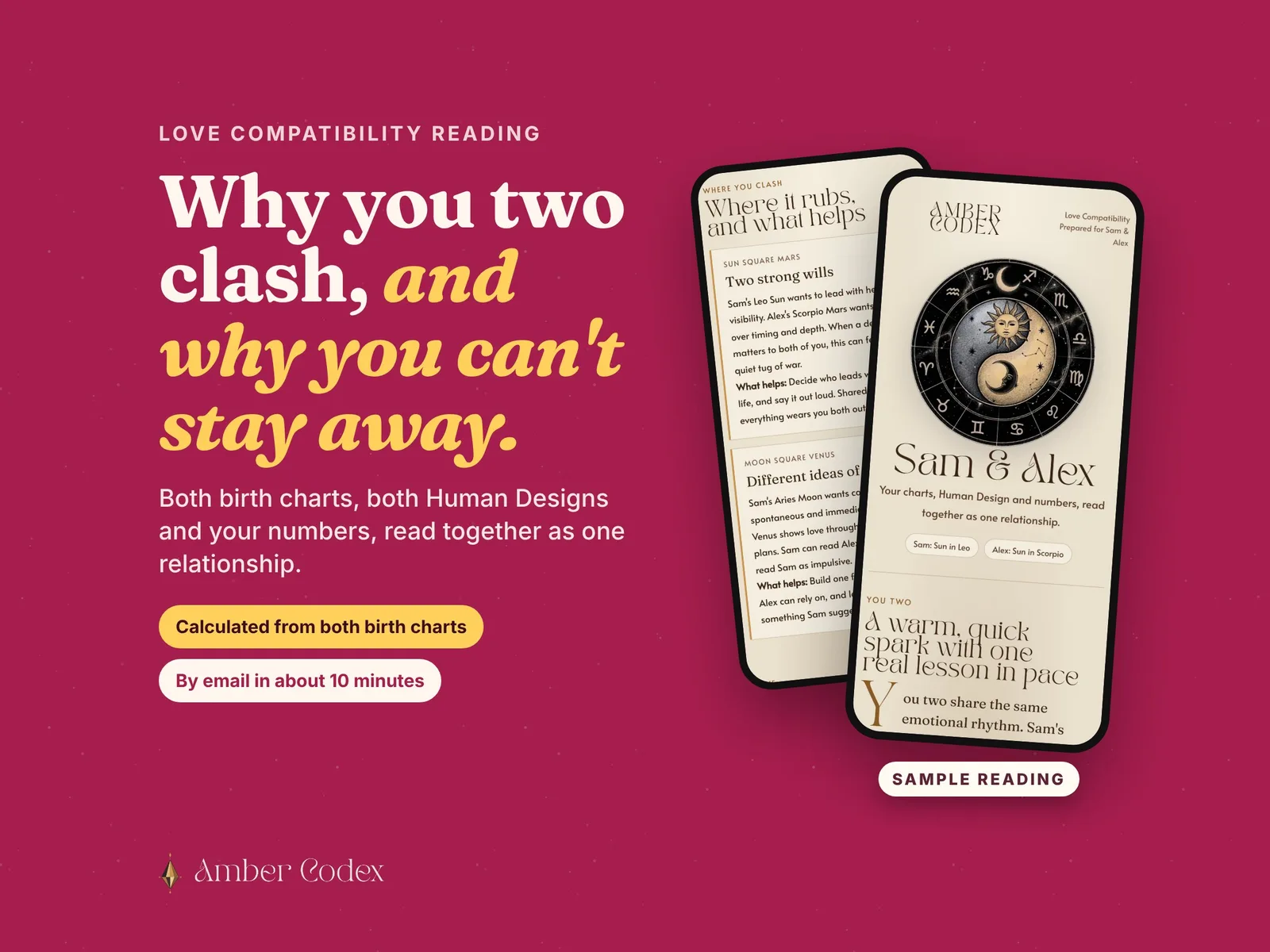
Sun sign compatibility, Aries with Leo, Cancer with Pisces, is the horoscope-column version of a much richer practice. Synastry lays one person's whole birth chart over the other's and looks at where the planets touch. Done honestly, it does not tell you whether a relationship will last. It tells you where it flows, where it rubs, and what each of you is likely to feel without being able to say why.
What a contact is
A contact, or aspect, is a geometric relationship between a planet in one chart and a planet in the other: the same place (conjunction), opposite (opposition), a quarter of the circle apart (square), a third (trine) or a sixth (sextile). Trines and sextiles are called flowing: they come easily. Squares and oppositions are called friction: they create tension, and tension is where growth and most of the chemistry live. A conjunction blends the two planets, for better or worse. The closer the angle to exact, the stronger it is.
The five contacts astrologers look at first
1. Sun to Moon
The classic. One person's core identity meeting the other's emotional needs. A flowing contact here is the feeling of being understood without explaining. A friction contact is loving someone whose way of being safe is not your way of being yourself.
2. Venus to Mars
Attraction, plainly. Venus is what we find lovely, Mars is what we want. When one person's Venus touches the other's Mars, the pull is physical and obvious, and it does not much matter whether the aspect is flowing or friction: both are spark.
3. Moon to Moon
How your emotional weather systems meet. Flowing Moon contacts make living together easy. Squared Moons can mean two people who both need comfort at exactly the moment the other has none to give.
4. Venus to Venus
Whether you enjoy the same things: the same idea of a good evening, a good gift, a good life. Underrated, because it is what the day to day is made of.
5. Saturn to the Sun or Moon
Saturn is commitment and limits. A Saturn contact can feel like safety and structure, or like being judged, often both. Long relationships very often have strong Saturn contacts, because Saturn is what makes people stay.
Why a high friction count is not a bad sign
Some charts have far more friction contacts than flowing ones, and people see that number and panic. Do not. A pairing with no friction can feel pleasant and flat; a pairing with plenty of it has heat, and the real question is whether the flowing contacts give the tension somewhere to land. The useful reading never scores a relationship as a percentage. It names the specific contacts and says what helps with each.
Beyond the two charts
There are two more layers worth knowing. The composite chart averages the two charts into one, the chart of the relationship itself as a third thing, and its Sun and Moon say what the relationship is for. And if both people know their birth time, Human Design adds the channels you complete for each other, which describes attraction in a very different language from astrology. When the astrology, the Human Design and the numbers point the same way, that is worth paying attention to.
Synastry works without exact birth times, though an exact time for each person adds the Rising signs, the houses and the full Human Design.
Both charts read together with your Human Design and numerology: where you click, where you clash, and what helps.
Questions
Which signs are most compatible?
Sun signs alone are a very rough guide. Synastry compares every planet in both charts, and a pairing of "incompatible" Sun signs can have excellent Moon and Venus contacts.
Do we need both birth times for synastry?
No. The planet to planet contacts work from the dates. Birth times add the Rising signs, the houses (where each person's planets fall in the other's life) and Human Design.
What is a composite chart?
A single chart made from the midpoints of two people's planets. Astrologers read it as the chart of the relationship itself.